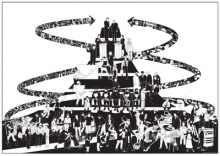
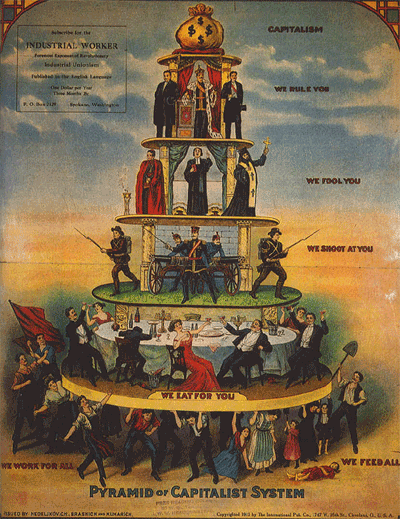
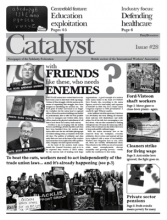
Design by prole.info, inspired by an old I.W.W. drawing, this poster is a portrayal of class society as it appears to us today. The whirlwind of market forces encircle and shape society, operating through our activity, yet behind our backs. People at different levels of the modern capitalist pyramid enjoy it or defend it or cope with it or fight it or get drunk to forget about their place in it.
A1 size, £4 plus p&p.
The original drawing appeared in 1911 the Industrial Worker, the newspaper of the Industrial Workers of the World. The inscriptions on the pyramid are : We rule you - we fool you - we shoot at you - we eat for you - we feed all- we work for all.
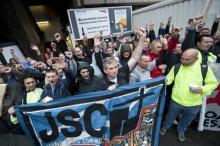
The electricians had called a national day of action for the same day as the student protest of November 9th, which looked like it could have a lot of possibilities. Would these two very different movements be able to link up?
Bootle Strike Committee / Liverpool Against The Cuts
iconimage:
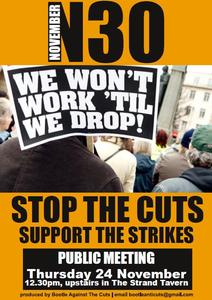
STOP THE CUTS!
SUPPORT THE STRIKES!
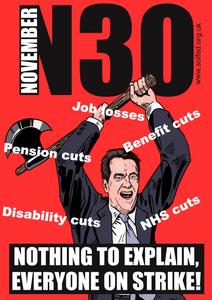
On November 30, workers from across the education and public sectors will be taking strike action to defend their pensions and fight off redundancies. We all need to support that strike.
Government cuts are attacking all of us. Each time a group of workers gets their pension slashed or receives a below inflation rise, it only emboldens other employers to do the same. Public or private, in a union or not, we can only beat the bosses' onslaught by standing together.
We’ve seen cuts to education, leading to the destruction of EMA, tripled uni fees, mass redundancies and course closures. We’re now witnessing – if we fail to stand up and beat it – the virtual privatisation of education. But the government’s austerity measures are not just attacking education – pensioners, the unemployed, workers in all industries in both public and private sector are all facing massive cuts – leaving no-one spared!
The next Manchester and Salford anarchist bookfair will be held at the Peoples (Labour) History Museum in Central Manchester from 10am till 4pm on Saturday December 4th 2011.
This excellent new venue is just short walk from Manchester Town Hall and Salford Central Rail station.
There will be a variety of stalls from radical bookstores, anarchist political groups and publishers and various campaigns as well as several topical discussion meetings.
Join the North London Solidarity Federation and the London Anarchist Federation as we discuss the November 9th student mobilisations and plan for the massive public sector strike due to occur on November 30th.
Last night, Liverpool Solidarity Federation members were amongst protesters gathered outside Liverpool Town Hall. They demonstrated as Liverpool City Council held a Budget Question Time in order to seek views on how they could save £50m in the coming year. Whilst the audience inside gave the councilors a hard time, those outside disrupted traffic by blocking off a road.
Throughout the current pensions dispute, the government has attempted to divide workers by claiming that public sector workers receive far better pensions when compared to those working in the private sector. This is certainly true. But what is never explained is just why private sector pensions are so much worse. This is not surprising given that the vast majority of private sector pension schemes amount to little more than a license for the financial sector to make shed loads of money.